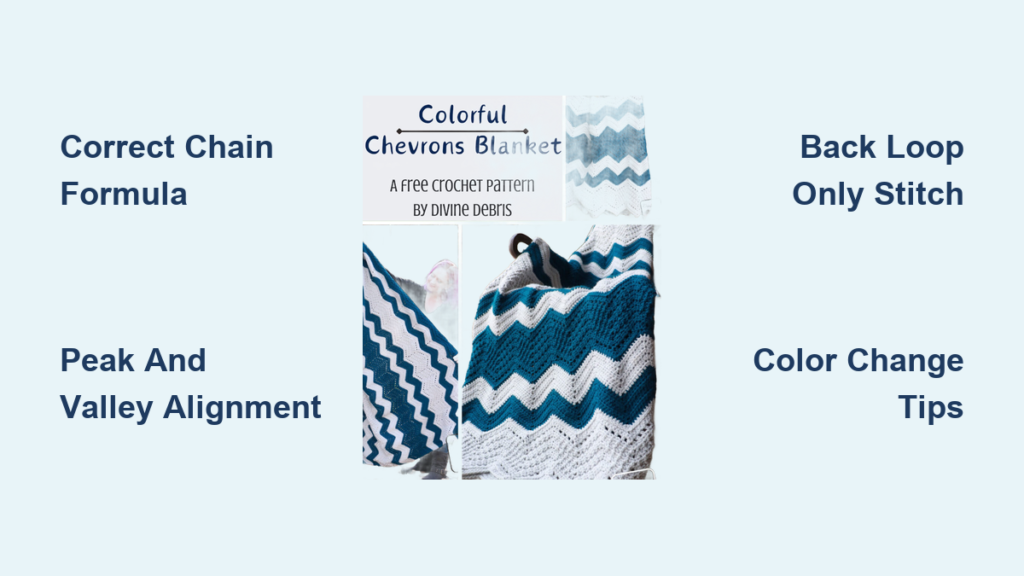
Creating a chevron blanket is one of the most satisfying crochet projects you can tackle. The flowing wave pattern adds eye-catching texture to any room, and once you master the rhythm of peaks and valleys, the work moves quickly. This guide covers everything from picking the right yarn and calculating your foundation chain to finishing with beautiful borders and tassels. You will learn the exact formulas that ensure your waves align perfectly, how to change colors smoothly, and how to fix common mistakes that trip up beginners.
Choose the Right Yarn and Hook for Your Chevron Blanket
Your yarn choice directly affects how your blanket looks, feels, and works up. The weight you select determines both the drape and the finished size of your project.
Select Your Yarn Weight
Worsted weight yarn is the most popular choice for chevron blankets because it balances speed, stitch definition, and affordability. It works up quickly while keeping each wave crisp and visible. Bulky or chunky yarn creates a plush, cozy throw that works up even faster but uses more yarn per project. DK or sport weight produces lighter blankets with beautiful drape, perfect for baby blankets or spring throws. Cotton yarn offers softness and breathability, making it ideal for baby items or summer blankets.
Pro Tip: Acrylic yarn is durable, affordable, and machine washable, which makes it perfect for everyday use blankets.
Match Your Hook Size
Using the correct hook size keeps your tension even and prevents the fabric from ruffling. The general rule is that larger hooks create a looser, drapier fabric, while smaller hooks produce tighter stitches.
| Yarn Weight | Recommended Hook Size |
|---|---|
| Fingering | 3–4 mm |
| DK or Sport | 4–5 mm |
| Worsted | 5.0–6.0 mm |
| Bulky or Chunky | 6.5–8.0 mm |
| Super Bulky | 8.0–9.0 mm |
Calculate Your Foundation Chain Correctly
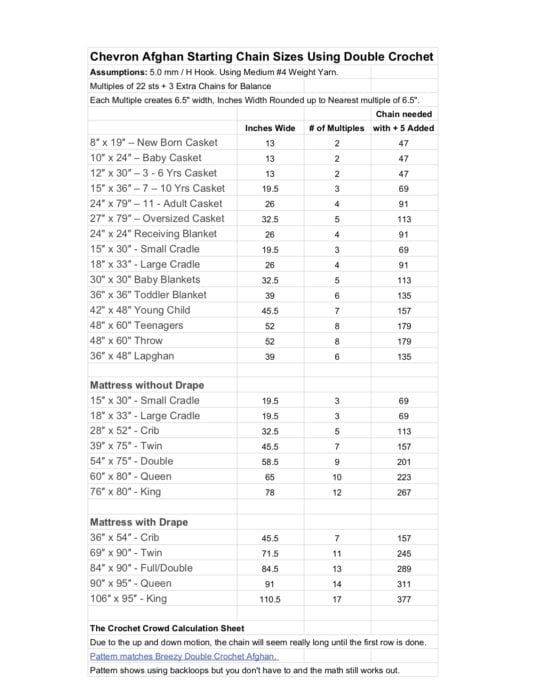
The foundation chain is the most critical step in making a chevron blanket. If your chain number is wrong, your peaks and valleys will not align, and the entire project will look skewed.
Use the Correct Chain Formula
Different stitch types require different chain formulas to achieve the proper width and alignment.
For Single Crochet Chevron: Use a multiple of 12 plus 2. For a baby blanket with 9 repeats, you would chain (12 × 9) + 2 = 110 chains, which produces approximately 24 inches in width.
For Double Crochet Chevron: Use a multiple of 14 plus 4. For a throw with 8 repeats, chain (14 × 8) + 4 = 116 chains, yielding approximately 50 inches in width.
For Bulky Yarn Chevron: Use a multiple of 16 plus 3. For 9 repeats, chain (16 × 9) + 3 = 147 chains, producing roughly 46 inches in width.
Critical Note: Chevron patterns shrink 2–4 inches from the foundation chain due to the peaks and valleys. Chain one extra multiple beyond your target width to account for this shrinkage.
Create Your First Wave Row
The first row establishes the rhythm that you will repeat throughout the entire blanket. Getting this right sets you up for success.
Single Crochet Chevron Row 1
Chain your calculated number, then work the foundation row as follows. Insert your hook into the second chain from the hook and the next chain together (sc2tog). Work 1 single crochet in each of the next 13 chains. Work 3 single crochets in the next chain to form the peak. Work 1 single crochet in each of the next 13 chains, then skip 2 chains to form the valley. Repeat this pattern across the entire row. Work a final sc2tog in the last 2 chains. Chain 1 and turn.
Double Crochet Chevron Row 1
Chain your required number. Work a double crochet in the fourth chain from the hook, which counts as your first double crochet. Work 1 double crochet in each of the next 5 chains. Work a dc3tog (double crochet three together) to form the valley. Work 3 double crochets in the next chain to form the peak. Repeat 5 dc, dc3tog, 3 dc across the row. End with 2 double crochets in the last chain. Chain 3 and turn.
Peak and Valley Basics: A peak is created by working 3 stitches into a single stitch. A valley is created by combining stitches together (sc2tog or dc3tog) and skipping stitches.
Master the Chevron Pattern Repeat
Once Row 1 is complete, the remaining rows follow a repeating pattern that mirrors the foundation row.
Continue Single Crochet Rows
Work sc2tog in the first 2 stitches to start the row. Work 1 single crochet in each of the next 13 stitches. Work 3 single crochets into the center stitch of the previous peak. Work 1 single crochet in each of the next 13 stitches, then skip 2 stitches from the previous row to complete the valley. Repeat this pattern across the row. End with sc2tog in the last 2 stitches. Chain 1 and turn.
Continue Double Crochet Rows
Chain 3 (which counts as your first double crochet) and work 1 more double crochet in the same stitch. Work 5 double crochets, then dc3tog in the valley, then 3 double crochets in the peak center. Repeat this pattern across. End with 2 double crochets into the top of the turning chain from the previous row. Chain 3 and turn.
Pro Tip: Place stitch markers at the center of each peak to help you stay aligned, especially in the first few rows.
Add Texture with Back Loop Only
Working in the back loop only (BLO) creates horizontal ridges that make the wave pattern pop and help stitches stack neatly.
How to Work BLO
After turning your work, insert your hook into the back loop of each stitch, which is the loop farthest from you. Continue your pattern as usual, but only through this single loop. This technique works especially well with single crochet chevrons.
Bonus: BLO adds stretch, reduces curling, and gives a ribbed, professional finish to your blanket.
Change Colors for Striking Stripes
Adding color changes transforms a simple chevron into a stunning visual piece. Planning your color sequence in advance ensures beautiful results.
Switch Yarn at Row End
Complete all but the last pull-through of your final stitch. Yarn over with your new color and pull through to finish the stitch. Chain 1 (for single crochet) or chain 3 (for double crochet) with the new color. Begin the next row in the new color.
Carry Yarn to Reduce Ends
To avoid cutting yarn every few rows, carry the unused color along the edge. Work over the unused yarn for 2–3 stitches to secure it, then continue with your active color. Weave in the ends later with a tapestry needle.
Design Tip: Change color at the valley to emphasize the dip in the wave pattern.
Decide Your Stripe Width
Work color changes every 6 rows for a balanced, classic look. Change every 1–2 rows for bold, high-contrast stripes. Change every 10 or more rows for subtle, spaced color blocks.
Fix Common Chevron Problems
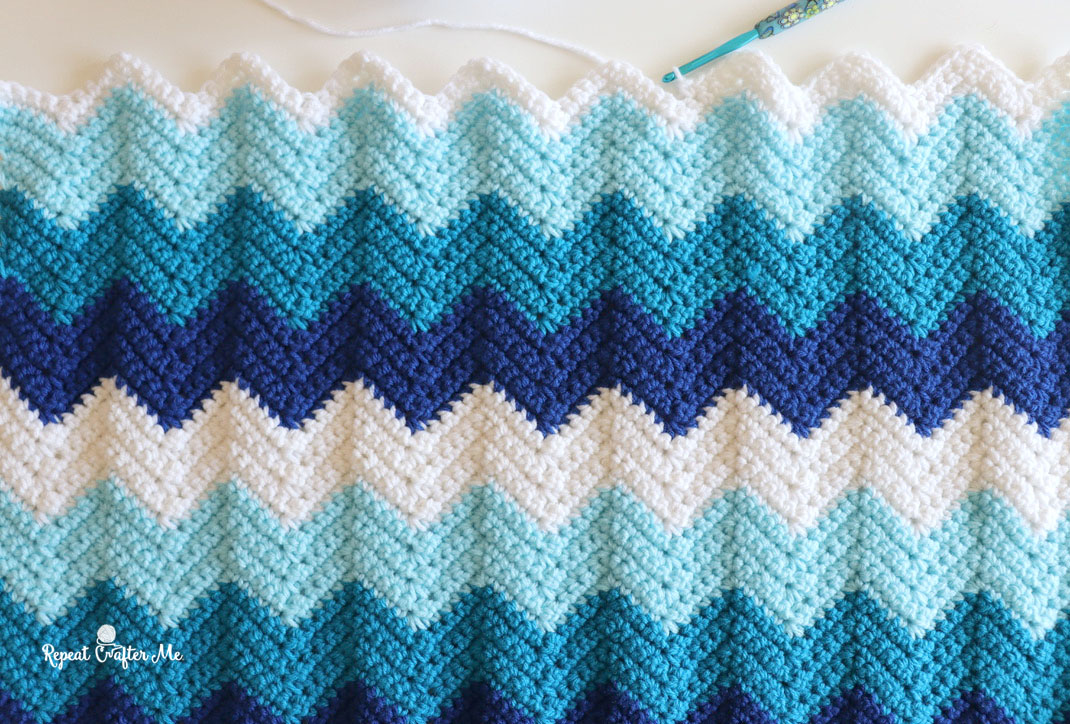
Even experienced crocheters run into issues with chevron patterns. Knowing how to troubleshoot keeps your project on track.
Misaligned Peaks and Valleys
If your waves look uneven, check these common causes. Did you skip exactly 2 stitches after each 13-stitch section? Skipping only 1 or 3 breaks the rhythm. Are you working 3 stitches into the center stitch of the peak? Working into the side stitch throws off alignment. Count your stitches regularly; you should have 9 stitches on each side of every peak.
Prevent Ruffling and Curling
| Problem | Cause | Solution |
|---|---|---|
| Ruffling edges | Too many stitches | Recalculate your chain using the correct formula |
| Tight foundation | Tension too firm | Use a larger hook just for chaining |
| Gaps at peaks | Inconsistent skipping | Keep your skip count consistent |
| Extra stitch at end | Incorrect turning chain | Do not count the turning chain as a stitch |
Christina’s Tip: If edges are uneven, try crocheting into the loop of the turning chain instead of the last stitch.
Customize Your Blanket Size
The chain formulas allow you to scale your blanket up or down to any size you need.
Standard Blanket Sizes
A baby blanket typically ranges from 24 to 34 inches wide, requiring 110 to 177 chains in single crochet. A throw blanket measures 50 to 60 inches wide and needs approximately 221 to 293 chains. A full-sized afghan at 50 by 60 inches requires a multiple of 21 up to about 105 chains per the width formula.
Estimate Your Yarn Needs
A baby blanket typically requires 1 to 2 skeins per color. A large throw needs 1,000 to 2,000 yards of worsted weight yarn. For a 46 by 60 inch blanket in bulky yarn, you will need approximately 12 cakes (about 1,968 yards).
Add a Polished Border
A border frames your chevron blanket and hides any edge inconsistencies, giving your project a professional finish.
Single Crochet Border
Work 1 single crochet per stitch along the sides. At peaks, work 3 single crochets into the center stitch of the 3-stitch cluster. At valleys, work sc3tog over the decrease area. At corners, work 2 single crochets, chain 2, then 2 single crochets. Along vertical edges, work approximately 2.5 single crochets per row.
Add Tassels or Fringe for Decorative Flair
Tassels add a playful touch to your finished blanket.
Attach Tassels to Peak Points
Cut yarn into 4-inch lengths. Fold each piece in half to form a loop. Use a crochet hook to pull the loop through the corner of each peak. Pull the yarn ends through the loop and pull tight to knot. Trim the ends evenly for a clean look.
Frequently Asked Questions About Making a Chevron Blanket
How long does it take to make a chevron blanket?
The time depends on your experience level and blanket size. A baby blanket in worsted yarn typically takes 6 to 10 hours. A large throw may take 15 to 25 hours. The pattern works up quickly once you establish the rhythm.
What is the easiest yarn weight for beginners?
Worsted weight (Category 4) is the easiest for beginners. It is widely available, affordable, and provides good stitch visibility so you can see your peaks and valleys clearly.
Why does my chevron blanket look ruffled?
Ruffling usually means your foundation chain has too many stitches. Recalculate your chain using the correct formula for your stitch type. Using a larger hook for the initial chain can also help.
Can I use different stitch heights in one blanket?
Yes. Many crocheters alternate between single crochet and double crochet sections. Try 10 rows in single crochet, then 10 rows in double crochet for interesting texture contrast.
How do I make my chevron blanket wider or narrower?
Adjust the number of repeats in your foundation chain. Use the formula for your stitch type and multiply by the number of repeats you want. Remember to chain one extra multiple to account for shrinkage.
Key Takeaways for Making a Perfect Chevron Blanket
The foundation chain formula is the most important element to get right. Without the correct multiple, your peaks and valleys will not align no matter how carefully you crochet. Take time to calculate and measure your chain before starting Row 1.
Working in the back loop only creates beautiful horizontal ridges that make the wave pattern stand out while preventing curling. This simple technique elevates your blanket from good to professional quality.
Color changes add tremendous visual impact with minimal effort. Whether you prefer bold stripes, subtle gradients, or automatic color-changing yarn, planning your color sequence in advance produces the most polished result.
Now that you understand the formulas, techniques, and troubleshooting tips, you are ready to create your chevron blanket. Gather your materials, calculate your chain, and enjoy the meditative rhythm of watching the waves take shape under your hook.