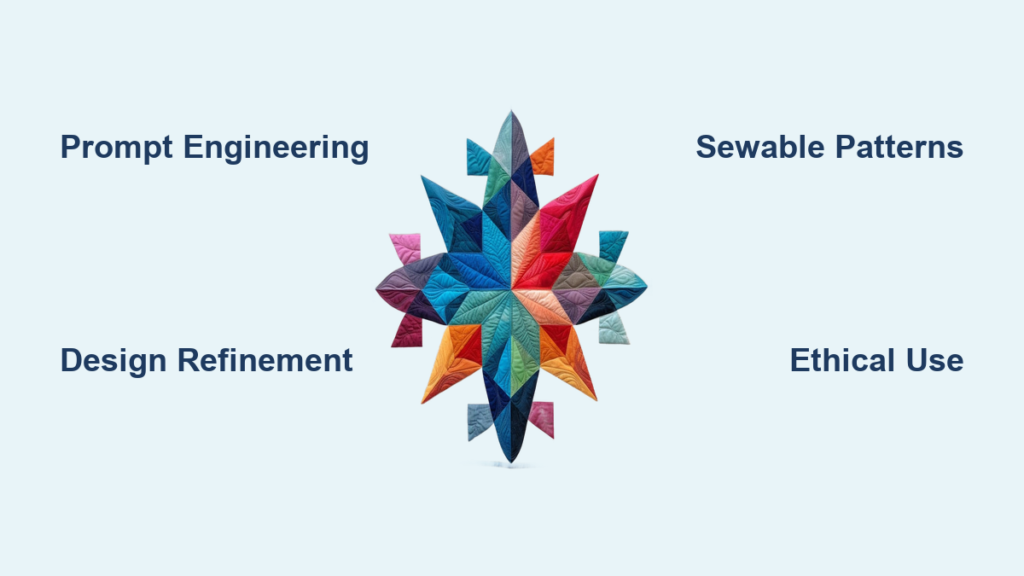
You’re staring at a blank design wall, fabric scattered but inspiration missing. What if you could type “vintage floral quilt, soft blues and ivories, Art Deco symmetry” and watch five stunning patterns appear in seconds? That’s the promise of generative AI quilt design, and it’s reshaping how modern quilters brainstorm, prototype, and market their work.
This guide walks you through the entire process, from writing your first prompt to sewing a finished quilt. You’ll discover the best AI tools, learn ethical guardrails, master prompt engineering, and explore real workflows that turn digital concepts into tangible textiles. Whether you’re a traditionalist, modern artist, or small business owner, you’ll find practical strategies for using AI thoughtfully and effectively.
Why Generative AI Quilting Sparks Ethical Backlash
Generative AI quilt design has ignited fierce debate across the crafting community. Many artisans view these tools not as innovation but as artistic theft, since AI models train on millions of images scraped from the internet, often including copyrighted quilt designs, without artist consent.
The “AI Slop” Controversy
Critics describe the flood of AI-generated visuals as “AI slop,” a term for low-effort, repetitive content saturating online spaces. For handcrafters who spend weeks piecing a single quilt, seeing an algorithm mimic their style in seconds feels like a betrayal. They argue that typing a prompt lacks the intention, skill, and emotional labor embedded in real textile art.
Environmental Cost of AI Image Generation
Few users realize the ecological footprint behind each AI image. Training large models consumes vast electricity and cooling water. Data centers powering these systems accelerate fossil fuel use and contribute to climate collapse. For a community often aligned with sustainability, this hidden cost clashes with core values.
The Human Touch Versus Digital Shortcuts
Many quilters choose the craft to escape screens and reconnect with tactile creation. The push to adopt AI tools feels tone-deaf to this desire. There’s concern that relying on algorithms erodes design skills, replacing intuition and experimentation with instant outputs.
SAQA’s Stance on AI-Generated Quilt Submissions
The Studio Art Quilt Associates (SAQA) has taken a nuanced position, reflecting the community’s divide. While some members oppose AI, the organization officially recognizes it as a valid artistic tool, with conditions.
The Transformation Rule for Exhibitions
To enter a SAQA exhibition, AI-assisted artwork must be transformed enough to reflect the artist’s unique vision. The key question centers on whether the final piece represents the human creator’s expression rather than just the AI’s output.
Physical Quilts as Proof of Transformation
SAQA currently assumes that a physical quilt implies sufficient transformation. Since AI cannot sew, any actual quilt made from fabric involves human decisions about color, texture, and stitching that ground the work in reality. This serves as a practical benchmark, though the definition remains subjective.
Warnings About Data Exploitation
Despite allowing AI use, SAQA acknowledges the ethical dilemma. Artists are advised that posting work online risks having it harvested for training data. Some advocates push for formal warnings against AI scraping rather than encouraging tool adoption.
How AI Quilt Design Works as a Creative Collaborator
Not all quilters see AI as a threat. Many embrace it as a digital design partner, a way to break creative blocks and explore new visual territory.
An Endless Brainstorming Partner
Proponents describe AI as an eclectic brainstorm buddy that generates color palettes, layouts, and motifs a human might never imagine. Need a quilt inspired by Scottish mountain data or a fusion of Art Nouveau and space motifs? AI delivers options in seconds.
Democratizing Design Access
Generative AI quilt design levels the playing field. You don’t need to draw or use complex software. With simple text prompts, anyone can visualize a quilt idea. For non-artists or those with limited technical skills, this opens doors to creative expression they once thought impossible.
Historical Precedent for New Tools
Critics once feared photography would kill painting, yet cameras became their own art form. Similarly, digital illustration was once dismissed but is now mainstream. AI may follow the same path from initial resistance to eventual integration.
AI Versus Image Search
Unlike Google Images, which retrieves existing files, AI generates new compositions from scratch. When you prompt “a quilt designed by Georgia O’Keeffe,” the result is a novel interpretation synthesized from learned patterns, not a copy.
Best AI Tools for Generative AI Quilt Design

Not all AI generators perform equally. Each platform has strengths depending on your design goals.
DALL-E for Traditional Patchwork Precision
OpenAI’s DALL-E excels at clean, symmetrical, and structured designs. It’s ideal for:
– Classic block patterns
– Geometric repeats
– Vintage-inspired layouts
New users receive 50 free prompts, making it a low-risk entry point. DALL-E tends to produce realistic, sewable-looking results with fewer impossible shapes.
Midjourney for Bold Artistic Flair
Midjourney dominates Instagram, where #midjourneyquilts has over 54,000 posts. Use it for:
– Abstract art quilts
– Whimsical or surreal themes
– Dramatic color contrasts
It requires a paid subscription, but its creativity is unmatched. However, results often need heavy editing to become physically constructible.
Stable Diffusion for Maximum Control
Stable Diffusion offers the most customization, ideal for users with a clear vision. You can fine-tune models, use control nets for precise shapes, and run it locally. Best for:
– Reproducing specific styles
– Generating foundation paper piecing templates
– High-detail pattern development
This tool requires more technical skill but offers unparalleled flexibility.
NightCafe for Community and Challenges
NightCafe combines AI generation with a supportive community. It hosts daily challenges, voting, and showcases. Great for:
– Beginners learning prompt engineering
– Finding inspiration from other creators
– Experimenting with different styles
The platform allows commercial use and encourages sharing, making it a social hub for AI quilters.
Writing Prompts That Generate Stunning Quilt Designs
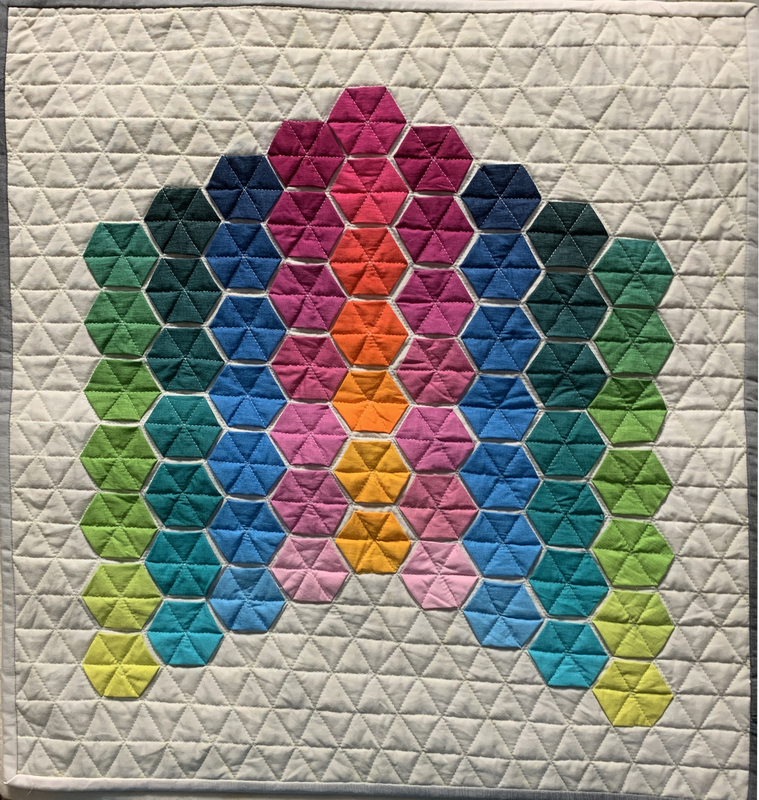
Your prompt is the blueprint. A vague request like “quilt design” yields generic results, while precision unlocks potential.
Core Prompt Structure for Quilt Generation
Use this formula: style plus motif plus colors plus specific details plus context.
Example: “Modern geometric quilt with hexagons in terracotta, mustard, and sage, high contrast, hanging in a sunlit minimalist living room.”
Style Keywords That Improve Results
Effective style descriptors include:
– “Traditional patchwork”
– “Art quilt, abstract expressionist”
– “Minimalist, asymmetrical”
– “Vintage 1930s reproduction”
– “Cubist-inspired, fragmented”
Color and Palette Control
Be specific with colors:
– “Earthy tones with pops of cobalt”
– “Monochromatic indigo gradient”
– “Five-color palette: cherry red, cream, kelly green, navy, gold”
AI responds better to named colors than abstract terms like “warm” or “vibrant.”
Requesting Seamless Repeating Patterns
For borders or large-scale designs, add “seamless repeating pattern” or “tiled design, no visible edges.” This instructs the AI to create a loopable image perfect for continuous quilting motifs.
Emulating Famous Artist Styles
Try prompts like:
– “A quilt designed by Anni Albers, Bauhaus style”
– “Inspired by Gee’s Bend quilts, improvisational layout”
– “Mark Rothko color field interpretation in fabric”
These tap into learned artistic movements, producing conceptually rich designs.
Turning AI Images Into Sewable Quilt Patterns

An AI-generated image isn’t a pattern. It’s a concept. Turning it into a quilt requires human translation.
Step 1: Select and Refine the Design
Download the highest-resolution version available. Import the image into editing software like GIMP, Photoshop, Affinity Photo, or Canva. Clean up distortions, align seams, and clarify shapes. Use layers to trace over the AI output and create a clear line drawing.
Step 2: Correct Structural Impossibilities
AI doesn’t understand fabric physics. Common issues include:
– Floating pieces with no seam allowances
– Curves that can’t be pieced traditionally
– Overlapping elements that defy layering
Redraw problem areas to ensure every piece can be cut and stitched.
Step 3: Create a Construction Plan
Break the design into manageable phases:
1. Foundation: Will you foundation paper piece, strip piece, or appliqué?
2. Color Map: Assign fabrics to each section.
3. Assembly Order: Sequence the blocks logically.
This step transforms a visual into a buildable project.
Step 4: Test with Paper Mock-Ups
Print a small-scale version and cut paper shapes to test the layout. This reveals errors before you cut precious fabric.
Using AI for Quilt Photography and Marketing Backdrops

Many quilters use generative AI quilt design not for patterns but for visual storytelling.
Generate Realistic Display Settings
Instead of hauling quilts outdoors for photos, prompt AI to create stunning backdrops:
– “Rustic barn roof with fairy lights, sawdust floor, flowers in rafters”
– “Modern loft with concrete walls and hanging plants”
– “Cozy cabin bedroom with pine walls and morning light”
Use photo editing tools to composite your real quilt into the AI-generated scene.
Promote on Social Media
AI-generated visuals stand out on Instagram and Pinterest. Use them for:
– Product listings
– Workshop promotions
– Design reveals
Ensure transparency by labeling AI-assisted content to maintain audience trust.
Copyright Rules for Generative AI Quilt Designs
The law lags behind technology. Here’s what you need to know before selling AI-assisted work.
No Copyright for Raw AI Output
According to Reuters (August 2023) and U.S. Copyright Office rulings, AI-generated images cannot be copyrighted because they lack human authorship. If you submit only the AI file, it falls into the public domain.
Human Transformation Creates Ownership
If you significantly alter the image by redrawing, stitching, or adding original elements, the final work may be protected. In quilting, the physical quilt is often seen as the transformed piece eligible for copyright.
Commercial Use Depends on Platform
Check your AI tool’s Terms of Service before selling:
– Midjourney (paid plan): Allows commercial use
– DALL-E: Permits users to own generated content
– NightCafe: Grants commercial rights
Always verify before selling designs or products.
Foundation Paper Piecing and the AI Design Flood

Foundation Paper Piecing (FPP) is especially vulnerable to AI mimicry due to its geometric, high-contrast nature.
AI Floods Etsy with Fake Patterns
Sellers are using AI to generate thousands of FPP designs and list them as originals. Many are unoriginal, low-effort, or structurally flawed. This devalues authentic, hand-drafted patterns.
Detecting AI-Generated FPP Patterns
Look for these red flags:
– Impossible piece sequences with floating inner pieces
– Overly complex, nonsensical layouts
– Repetitive or hallucinated text in the pattern
Human-designed FPP has logical construction flow that AI often lacks.
Ethical Use for FPP Drafting
If used ethically, AI can:
– Generate initial motif ideas
– Suggest color arrangements
– Speed up concept exploration
The final pattern should be redrafted and tested by hand to ensure accuracy and respect for the craft.
Environmental Costs Hidden in AI Quilt Generation
Using AI isn’t neutral. Every prompt carries a hidden cost.
Hidden Energy Consumption
Each AI image requires massive computing power. Data centers use gigawatts of electricity and millions of gallons of water for cooling. A single query can consume as much energy as charging a smartphone.
Supporting a System Built on Scraping
Most models trained on art taken without consent. By using them, you may indirectly support data exploitation. Some artists advocate for opting out of training via tools like Spawning’s Opt-Out or HaveIBeenTrained.com.
Sustainable AI Practices
If you choose to use AI:
– Limit unnecessary generations
– Use free tiers to reduce demand
– Credit human artists whose styles inspire your prompts
– Support original designers financially
Matching AI Quilt Design to Your Creative Goals
AI isn’t for everyone. Your goals determine its value in your practice.
The Modern Art Quilter
Ideal for generating abstract, narrative-driven pieces. Use AI to visualize data, emotions, or stories, then interpret them in fabric. The final quilt becomes a human response to machine input.
The Small Business Owner
Use AI for:
– Rapid pattern prototyping
– Creating marketing visuals
– Generating print-on-demand designs
Maintain authenticity by being honest with customers about AI use.
The Educator
Teach design principles using AI. Show how color theory, composition, and style affect outcomes. Use it to spark discussions about ethics in art and technology.
The Traditionalist
You may choose to opt out entirely. There’s no obligation to adopt AI. Many find deeper satisfaction in unplugged, hand-led creation.
Frequently Asked Questions About Generative AI Quilt Design
Can AI-generated quilt designs be copyrighted?
According to Reuters (August 2023) and U.S. Copyright Office rulings, raw AI-generated images cannot be copyrighted because they lack human authorship. However, if you significantly transform the output by redrawing, stitching, or adding original elements, the final physical quilt may qualify for copyright protection.
What is the best AI tool for quilt design?
The best tool depends on your goals. DALL-E excels at clean, symmetrical, traditional patchwork and offers 50 free prompts. Midjourney produces bold, artistic results popular on Instagram. Stable Diffusion offers maximum control for technical users. NightCafe provides community features and daily challenges.
Is generative AI quilt design ethical?
Opinions vary widely. Critics argue AI models train on copyrighted artwork without consent and produce “AI slop” that devalues handcraft. Proponents see it as a collaborative tool that democratizes design. SAQA allows AI-assisted quilts if sufficiently transformed. The ethics depend on your sourcing, transparency, and treatment of human artists.
How do you turn an AI quilt image into a real pattern?
Import the high-resolution AI image into editing software like Photoshop or GIMP. Correct structural impossibilities such as floating pieces or unworkable curves. Create a construction plan covering foundation method, color mapping, and assembly order. Test the layout with paper mock-ups before cutting fabric.
Does SAQA allow AI-assisted quilts in exhibitions?
Yes, SAQA considers AI generators valid tools. However, artwork submitted to their shows must be “transformed enough to make it uniquely the member’s creation.” The organization assumes that a physical quilt implies sufficient transformation, since AI cannot sew.
How much energy does AI quilt design use?
Each AI image requires substantial computing power from data centers that consume gigawatts of electricity and millions of gallons of cooling water. A single query can use as much energy as charging a smartphone. This environmental cost conflicts with sustainability values common in the quilting community.
Key Takeaways for Generative AI Quilt Design
Generative AI quilt design is here to stay, but it’s not replacing quilters. It’s a catalyst for ideas, not a substitute for skill. The most powerful designs emerge when human intention guides the machine, not the other way around.
Use AI to spark, not solve. Let it surprise you, then apply your expertise to make it real. Address ethical questions head-on, respect the artists whose work built these models, and credit transparency in everything you create.
Start small. Try DALL-E’s free 50 prompts with a simple quilt concept. Refine your results, test the layout in paper, and decide whether AI fits your creative practice. The future of quilting isn’t man or machine. It’s man with machine, used thoughtfully, skillfully, and humanely.