Quilting speaks through shapes, fabric, and tradition. At the heart of every quilt sit quilt blocks, the repeating units that give each piece its structure and story. Whether you are new to sewing or have stitched for years, understanding the types of quilt blocks opens the door to creative freedom and technical mastery. From simple four-patch squares to complex compass designs, each block family offers unique rewards.
This guide walks you through the major types of quilt blocks organized by structure, technique, and visual effect. You will learn how each block is built, what skills it develops, and how to choose the right one for your next project. By the end, you will recognize block families instantly and feel confident starting any quilt that catches your eye.
Grid-Based Quilt Blocks

Grid-based blocks form the foundation of traditional quilting. They divide a square into equal sections, creating predictable patterns that are easy to scale and perfect for learning core piecing skills.
Four-Patch Block Variations
The Four-Patch is one of the simplest blocks you can make. Cut four equal squares, sew them in a two-by-two grid, and your block is complete. Its simplicity hides remarkable versatility.
- Structure: Two-by-two grid of equal squares
- Common variations: Pinwheel, Bow Tie, Broken Dishes, Diamond in a Square
- Best for: Scrap quilts and modern geometric layouts
- Color tip: Place contrasting colors opposite each other for visual punch
💡 Pro Tip: Try the Disappearing Four-Patch. Sew a standard block, cut it into quarters, rotate the pieces, and re-sew. You get a complex secondary pattern with almost no extra effort.
Nine-Patch Block Essentials
Older than the Four-Patch, the Nine-Patch features a three-by-three grid of nine equal squares. Pioneer quilters favored this block because it used small scraps efficiently while creating warm, sturdy quilts.
- Structure: Three-by-three grid of nine equal squares
- Classic examples: Churn Dash, Shoo Fly, Snowball, Friendship Star
- Unequal option: Some versions use a center square twice the size of outer pieces
- Skill focus: Seam pressing and nesting for clean joins
⚠️ Common Mistake: Inconsistent seam pressing causes nesting problems when blocks meet. Always press toward darker fabric or use chain piecing for uniformity.
Larger Grid Systems
As grids expand, so does design complexity. These blocks allow detailed center motifs and intricate borders.
- Five-Patch (5×5): Twenty-five units per block, ideal for central focus designs
- Example: Five Spot with alternating black and white squares forming diagonal chains
- Seven-Patch and higher: Used in pictorial or precision quilts
- Example: Album Quilt blocks, often custom-made for special occasions
Strip-Pieced Quilt Blocks
Strip piecing saves time by sewing long fabric strips together before cutting. This technique produces multiple units quickly and accurately.
Log Cabin Construction
One of the most iconic types of quilt blocks, the Log Cabin symbolizes home and hearth. The center square traditionally represents the fireplace, often cut from red fabric.
- Center square: Traditionally red, representing the hearth
- Light and dark sides: Two adjacent sides use light fabrics (sunlit), two use dark (shaded)
- Construction: Strips rotate around the center clockwise or counterclockwise
- Popular layouts: Courthouse Steps, Barn Raising, Streak of Lightning
🎨 Design Tip: Use high-contrast fabrics to emphasize the light and dark effect, or go scrappy for a modern twist.
Courthouse Steps vs. Log Cabin
The Courthouse Steps block shares similarities with Log Cabin but uses a different construction method. Instead of rotating strips around the center, you add strips to opposite sides first, then the remaining opposite sides.
- Symbolism: Represents the grand steps leading to a courthouse dome
- Color use: Often features three to five colors
- Effect: Symmetrical expansion rather than rotational spiraling
Rail Fence and String Blocks
These blocks excel at using up scraps while maintaining strong geometry.
- Rail Fence:
- Three or more strips sewn together, then cut into block-sized segments
- Resembles a rustic split-rail fence
- Variations include Corner Fence and Diagonal Rail Fence
- String Quilts:
- Irregular fabric strips sewn onto paper or fabric foundation
- No precise cutting required, perfect for tiny scraps
- Often paired with solid colors like black for dramatic contrast
⏳ Time-Saver: Cut all strips at once and chain piece them for dozens of blocks in minutes.
Star Quilt Blocks
Stars dominate quilt design with their symmetry, movement, and symbolism. They range from beginner-friendly patterns to expert-level challenges requiring precision and patience.
Classic Star Patterns
These stars use grids or simple units, making them accessible and timeless.
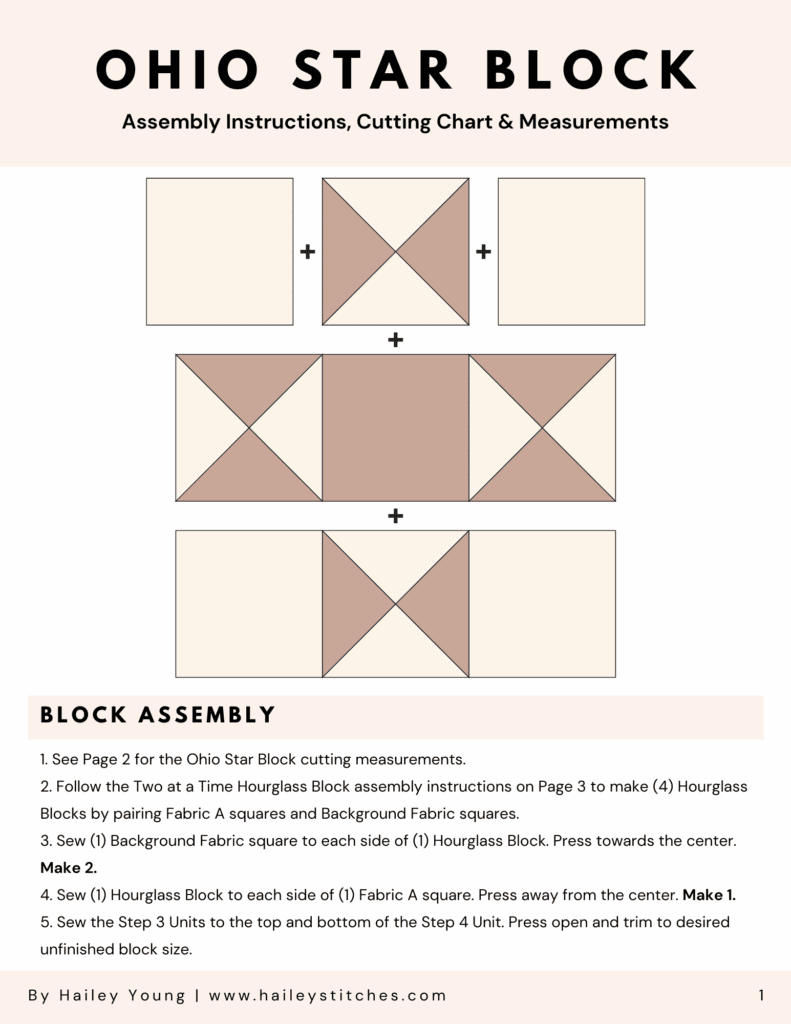
- Ohio Star:
- Built on a nine-patch grid
- Four half-square triangles form the points around a center square
- Clean, bold, and hypnotic in repetition
- Sawtooth Star:
- Eight Flying Geese units point outward from a center
- Creates a sharp, jagged edge with strong visual pop
- Excellent for mastering the Flying Geese technique
- Friendship Star:
- Similar to Ohio Star with more open space
- Traditionally used in signature quilts where friends add fabric or signatures
Complex Star Designs
These require precision, planning, and sometimes special techniques like paper piecing.
- LeMoyne Star:
- Eight-pointed star made entirely from diamonds
- Requires Y-seams or paper piecing for accuracy
- A true test of patience and skill
- Mariner’s Compass:
- Radiating points mimic a nautical compass
- Often paper-pieced for sharp angles
- Symbolizes guidance, navigation, and exploration
- Lone Star:
- One massive star spanning the entire quilt
- Made from dozens of diamond pieces
- Set on point with intricate matching
🌟 Symbolism Alert: Stars often represent hope, direction, or celestial events, including blocks like Moon and Stars or Big Dipper.
Curved Quilt Blocks
Curved blocks introduce bias edges and require careful handling. They offer unmatched flow and softness in finished quilts.
Drunkard’s Path and Quarter Circle
These blocks look similar but have subtle structural differences.
- Quarter Circle:
- The curved unit fills the corner completely
- Pieces meet in an X pattern at the center
- Often used in checkerboard layouts
- Drunkard’s Path:
- The curved unit (the “melon”) does not touch the sides
- When repeated, creates a winding path effect
- Teaches matching concave and convex curves
📌 Technique Tip: Pin at center and quarter points, use a shorter stitch length, and press gently to avoid stretching bias edges.
Orange Peel and Wedding Rings
These beloved blocks bring organic, flowing shapes to quilt designs.
- Orange Peel:
- Central melon shape with four curved corners
- Resembles citrus segments or flower petals
- Soft, feminine, and striking in bold modern colors
- Double Wedding Ring:
- Interlocking circles made from curved arcs and corner squares
- Symbolizes unity, connection, and lasting commitment
- Traditionally challenging, though modern templates simplify construction
🧵 Modern Twist: Designers like Victoria Findlay Wolfe use odd numbers of wedges or bold graphic fabrics to modernize these classic curved blocks.
Applique and Pictorial Blocks

These blocks tell stories, depict nature, or celebrate symbols. They often use applique, which means sewing fabric shapes onto a background.
Floral and Nature Motifs
Perfect for seasonal or themed quilts, these blocks bring nature indoors.
- Floral designs: Rose of Sharon, Tulip Lady Fingers, Squash Blossom, Cactus Rose
- Tree and plant designs: Maple Leaf, Pine Tree, Grapevine
- Iconic figures: Sunbonnet Sue, a girl in a bonnet featured in vintage children’s quilts
✂️ Applique Methods:
– Hand-stitched: Traditional, portable, soft finish
– Machine-stitched: Faster, durable, with satin or blanket stitch
– Fusible web: Iron shapes on, then stitch, great for beginners
Animal and Symbolic Blocks
These blocks carry meaning and charm beyond their visual appeal.
- Bear’s Paw: Symbolizes strength, protection, and motherhood
- Birds in the Air, Swallow, Eagle: Represent freedom and movement
- Butterfly, Honey Bee: Symbolize nature and transformation
📜 Historical Note: Sunbonnet Sue became a cultural icon through 20th-century primers and pattern books, appearing in countless variations across generations.
Optical Illusion Blocks
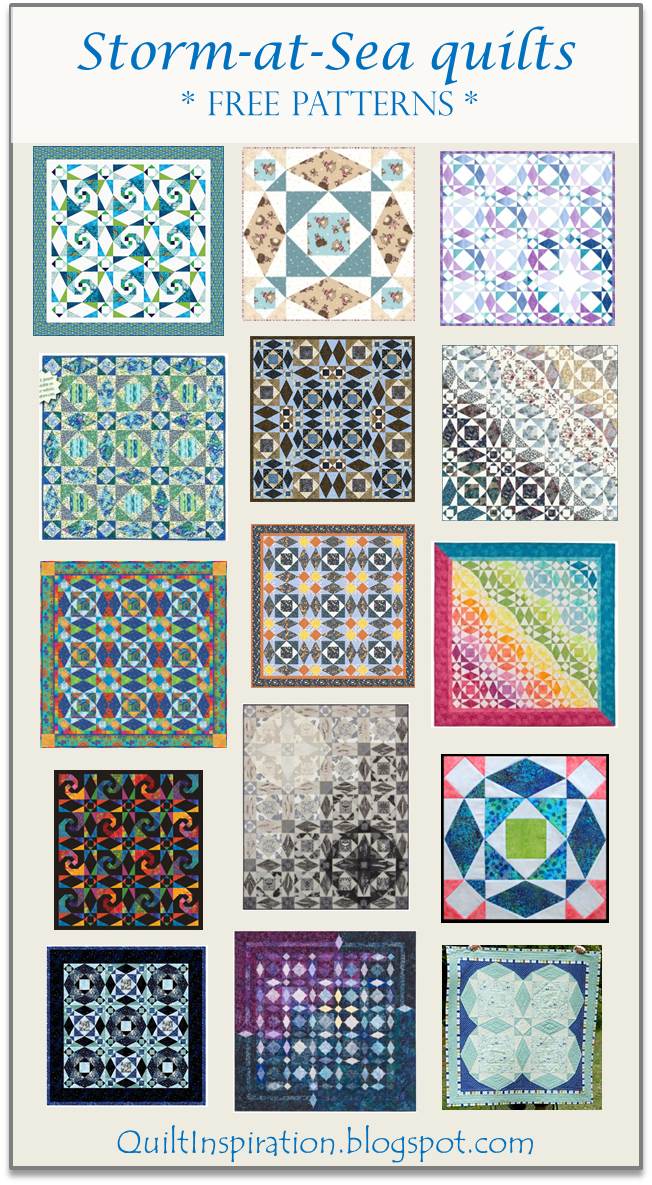
These blocks trick the eye, creating movement, depth, or curves from straight lines alone.
Storm at Sea
A stunning example of optical magic built from simple shapes.
- Structure: Alternating rows of squares, rectangles, and diamonds
- Effect: Looks like rolling waves, especially in light-to-dark gradients
- Symbolism: Represents life’s journey, resilience, and emotional tides
📐 Key to Success: Precise cutting and strong value contrast. Use a light-medium-dark palette for maximum wave effect.
Tumbling Blocks and Puzzle Designs
These create three-dimensional illusions from flat fabric.
- Tumbling Blocks:
- Three shades of diamonds form a cube effect
- Also called “crazy paving” or “falling boxes”
- Puzzle Blocks:
- Indian Puzzle, Grandmother’s Puzzle, Calico Puzzle
- Interlocking shapes resembling jigsaw pieces
- Challenge the mind as much as the hands
🧠 Pro Insight: Optical illusion blocks are excellent for teaching value perception and spatial reasoning while creating stunning visual impact.
One-Patch and Foundation Blocks
Sometimes the simplest approach makes the boldest statement. These quilts use a single repeated shape rather than composite blocks.
Hexagon-Based Designs
- Grandmother’s Flower Garden:
- One-patch quilt made entirely of hexagons
- Center flower (often yellow) surrounded by colorful petals
- Traditionally hand-pieced using English paper piecing
- Hexagon Flower:
- A single flower cluster, often used as a medallion
🪡 English Paper Piecing (EPP):
– Baste fabric over paper hexagons
– Whip-stitch pieces together
– Remove papers when complete
– Ideal for portable, meditative stitching
Tumblers and Rectangles
- Tumblers: Elongated hexagons that appear to tumble across the quilt
- Brickwork, Checkerboard: Use rectangles or squares in offset rows for simple but effective designs
Skill-Based Block Recommendations

Choose your next block based on your current skill level and what you want to learn.
Beginner-Friendly Blocks
Start here to build confidence and master fundamentals.
- Recommended blocks: Four-Patch, Nine-Patch, Rail Fence, basic Log Cabin, Half Square Triangles
- Why these work: Straight seams, forgiving alignment, quick results
- Skills learned: Quarter-inch seam accuracy, pressing techniques, chain piecing
Intermediate Challenges
Level up with precision work and sub-unit assembly.
- Recommended blocks: Flying Geese, Ohio Star, Churn Dash, Disappearing Nine-Patch
- Why these work: Introduce half-square triangles, quarter-square triangles, and trimming
- Skills learned: Unit assembly, seam nesting, accuracy under pressure
Advanced Masterpieces
For the patient and precise quilter ready for complex work.
- Recommended blocks: Double Wedding Ring, LeMoyne Star, Mariner’s Compass, Feathered Star, Storm at Sea
- Why these work: Involve curves, Y-seams, paper piecing, or extreme precision
- Skills learned: Bias handling, pattern matching, advanced planning
Modern Twists on Traditional Blocks
Today’s quilters reinvent classics with bold choices and fresh perspectives.
- Wonky Quilting: Intentionally misaligned lines for a playful, modern look
- Examples include: Wonky Stars, Wacky Log Cabin
- Oversized Blocks: A single 14-inch Log Cabin serving as the focal point
- Color Clashes: Neon centers in a Mariner’s Compass, or black-and-white with one red block
- Layout Innovation: Setting blocks on point, adding sashing, or mixing block types
🎨 Design Freedom: A Friendship Star in hot pink and black feels completely different from one in traditional calico prints. Color transforms everything.
Frequently Asked Questions About Types of Quilt Blocks
What is the easiest type of quilt block for beginners?
The Four-Patch and Nine-Patch are the easiest quilt blocks for beginners. Both use straight seams, equal-sized squares, and forgiving alignment. Rail Fence blocks are also beginner-friendly because they simply require sewing strips together and cutting segments.
How many types of quilt blocks exist?
Thousands of named quilt blocks exist, but they fall into about eight major categories: grid-based, strip-pieced, star, curved, applique and pictorial, optical illusion, one-patch, and triangle or unit-based blocks. Many blocks share names or have regional variations.
What is the most popular traditional quilt block?
The Log Cabin is among the most popular traditional quilt blocks. Its symbolic center, versatile layouts, and ability to use scraps make it a favorite across generations. The Ohio Star and Nine-Patch also rank among the most widely made blocks in quilting history.
What is the hardest type of quilt block to make?
The Double Wedding Ring, LeMoyne Star, and Mariner’s Compass are among the hardest quilt blocks. They require curved piecing, Y-seams, or paper piecing techniques. The Feathered Star and Storm at Sea also demand extreme precision and patience.
What is the difference between a quilt block and a quilt pattern?
A quilt block is a single repeating unit, usually a square, that forms part of a larger design. A quilt pattern is the complete design including multiple blocks, sashing, borders, and layout instructions for the finished quilt top.
Can I mix different types of quilt blocks in one quilt?
Yes, mixing different types of quilt blocks creates visual interest and rhythm. Many modern quilters combine grid-based blocks with stars or appliques. Consistent color palette and scale help unify mixed block designs into a cohesive finished quilt.
Key Takeaways for Exploring Types of Quilt Blocks
Understanding the types of quilt blocks is like learning the alphabet of quilting. Each category, from grid-based and strip-pieced to star, curved, pictorial, and illusion designs, offers a different creative voice. The Log Cabin speaks of home, the Double Wedding Ring celebrates unity, and Storm at Sea captures life’s resilience.
Start with simple blocks to build core skills. Master the quarter-inch seam, learn to press consistently, and practice chain piecing. Then progress to intermediate blocks like Ohio Star and Flying Geese. When you feel confident, challenge yourself with curved or paper-pieced designs.
Your next step: choose one block from the beginner list and make a small sample. Cut four squares for a Four-Patch or nine squares for a Nine-Patch. Sew them together, press your seams, and hold your finished block in your hands. That single block is the beginning of your quilting journey.